
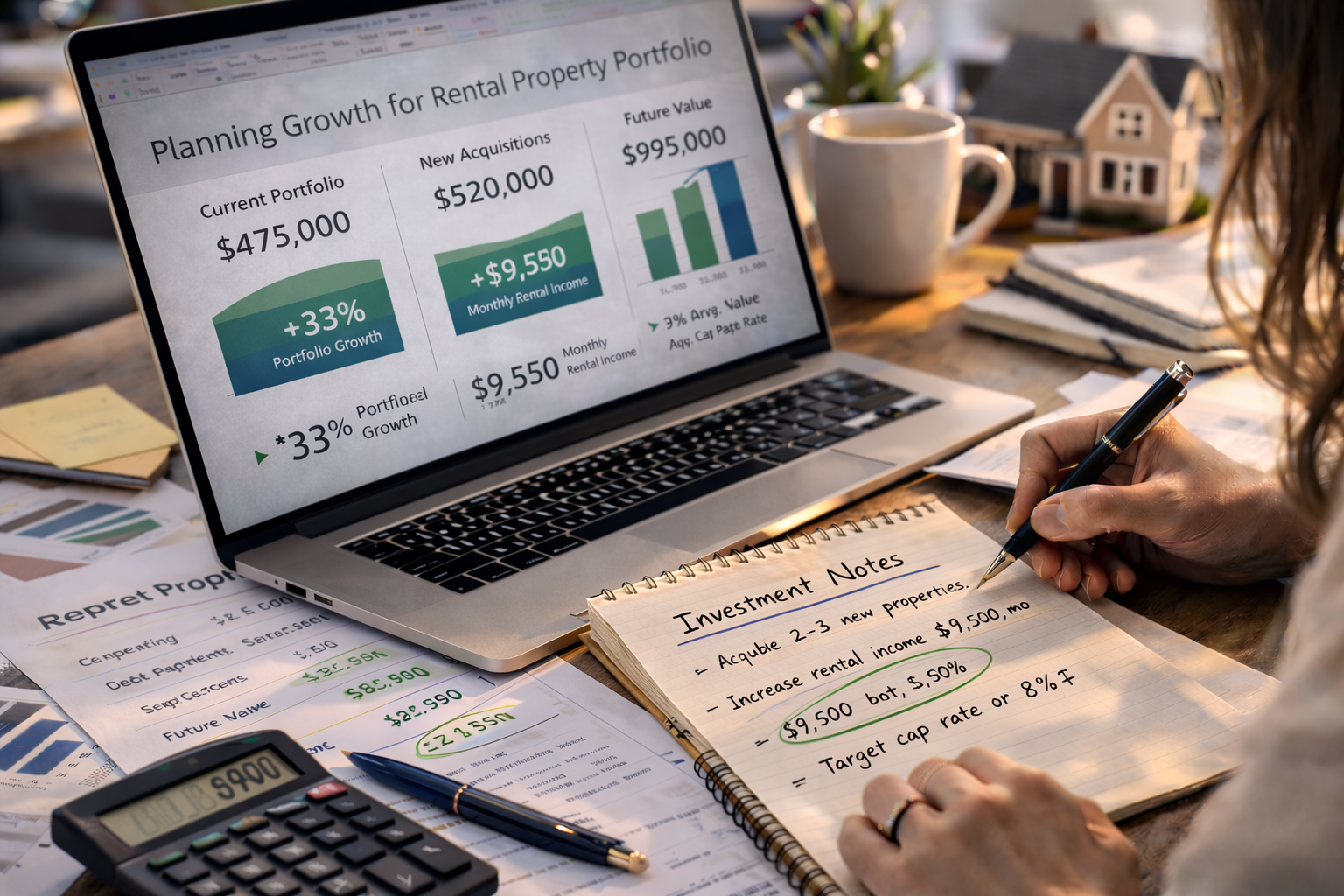
Building a Rental Property Portfolio
Building a rental property portfolio is one of the most common strategies investors use to generate long term income and financial independence. Rather than relying on a single property, investors gradually accumulate multiple rental units that produce cash flow, build equity through loan paydown, and potentially appreciate in value over time.
Successful portfolio growth requires disciplined acquisition strategies, careful financial analysis, and strong operational management.
If you are new to rental investing, begin with our guide to rental property cash flow.
Most rental property portfolios grow through a combination of consistent acquisitions, reinvested cash flow, property appreciation, and strategic refinancing.
Why Investors Build Rental Portfolios
Owning multiple rental properties offers several advantages compared to relying on a single investment.
- Diversified income streams
- Greater long term cash flow potential
- Reduced risk from individual property vacancies
- Equity growth through loan amortization
- Potential appreciation across multiple assets
As the portfolio grows, investors often experience increasing financial stability and income scalability.
Many investors initially focus on acquiring a few properties but later discover that portfolio growth accelerates as experience, financing options, and equity increase over time.
Step 1: Start With a Strong First Property
The first rental property often plays an important role in shaping an investor’s long term strategy. A well chosen property can generate cash flow, build equity, and create opportunities for future acquisitions.
Important factors when selecting the first property include:
- Strong rental demand
- Stable neighborhood fundamentals
- Reliable property condition
- Reasonable purchase price
- Positive projected cash flow
Understanding property performance begins with learning how to calculate rental property cash flow.
Step 2: Analyze Each Deal Carefully
Every property should be evaluated using multiple financial metrics before purchase. These metrics help investors determine whether a property supports long term portfolio growth.
Common evaluation metrics include:
- Cash flow
- Debt service coverage ratio (DSCR)
- Cap rate
- Cash on cash return
- Break even ratio
To understand how these metrics work together, see rental property return metrics.
Step 3: Use Financing Strategically
Financing plays a major role in portfolio growth. Leveraging financing allows investors to control larger assets with smaller initial capital.
Traditional mortgages may limit portfolio expansion because they rely heavily on personal income documentation.
Some investor loan programs instead evaluate the rental income generated by the property itself.
These programs often use Debt Service Coverage Ratio (DSCR) underwriting.
You can learn more about DSCR calculations in how to calculate DSCR for rental property.
To explore financing options for investors, see DSCR loan programs for rental property investors.
Step 4: Reinvest Cash Flow and Equity
Many investors accelerate portfolio growth by reinvesting profits from existing properties.
Common reinvestment strategies include:
- Saving rental income for down payments
- Refinancing properties to access equity
- Completing value add improvements to increase rent
- Using appreciation gains to expand acquisitions
Over time, these strategies can compound portfolio growth.
Step 5: Manage Risk as the Portfolio Expands
As portfolios grow, risk management becomes increasingly important. Investors must ensure that rental income remains stable and expenses are controlled.
Important risk management strategies include:
- Maintaining adequate financial reserves
- Diversifying property locations
- Monitoring vacancy rates
- Planning for maintenance expenses
- Maintaining strong tenant screening practices
Risk evaluation is discussed further in risk analysis for rental properties.
Operational Efficiency and Portfolio Performance
The long term success of a rental portfolio depends heavily on operational discipline. Leasing practices, tenant quality, maintenance planning, and vacancy management all influence financial performance.
Poor operational practices can quickly erode cash flow across multiple properties.
Strong operational systems allow investors to scale their portfolios more efficiently.
Operational discipline becomes increasingly important as rental portfolios grow. Tenant screening, maintenance management, leasing strategy, and vacancy control all influence portfolio stability and long term cash flow. Explore more landlord resources in our rental property cash flow hub.
How Many Properties Should a Portfolio Contain?
There is no universal portfolio size for real estate investors. Some investors focus on a small number of high quality properties, while others build larger portfolios to maximize cash flow and diversification.
Portfolio size depends on several factors including:
- Income goals
- Available capital
- Financing options
- Market opportunities
- Risk tolerance
If your long term goal is financial independence, see how many rentals you need to retire.
Long Term Portfolio Benefits
Over time, rental portfolios can produce several financial advantages.
- Recurring rental income
- Loan paydown funded by tenant rent
- Property appreciation
- Inflation resistant income
- Portfolio diversification
These factors help explain why rental property investing remains a popular long term wealth building strategy.
Related Rental Property Investment Guides
Continue learning about rental property investing with these resources:
- how to calculate rental property cash flow
- rental property expenses list
- rental property return metrics
- rental property break even analysis
- Rental property portfolios grow through consistent acquisitions and reinvestment
- Financial analysis helps identify sustainable investments
- Financing strategies influence portfolio growth speed
- Operational discipline becomes more important as portfolios expand
- Long term rental portfolios can generate both income and equity growth